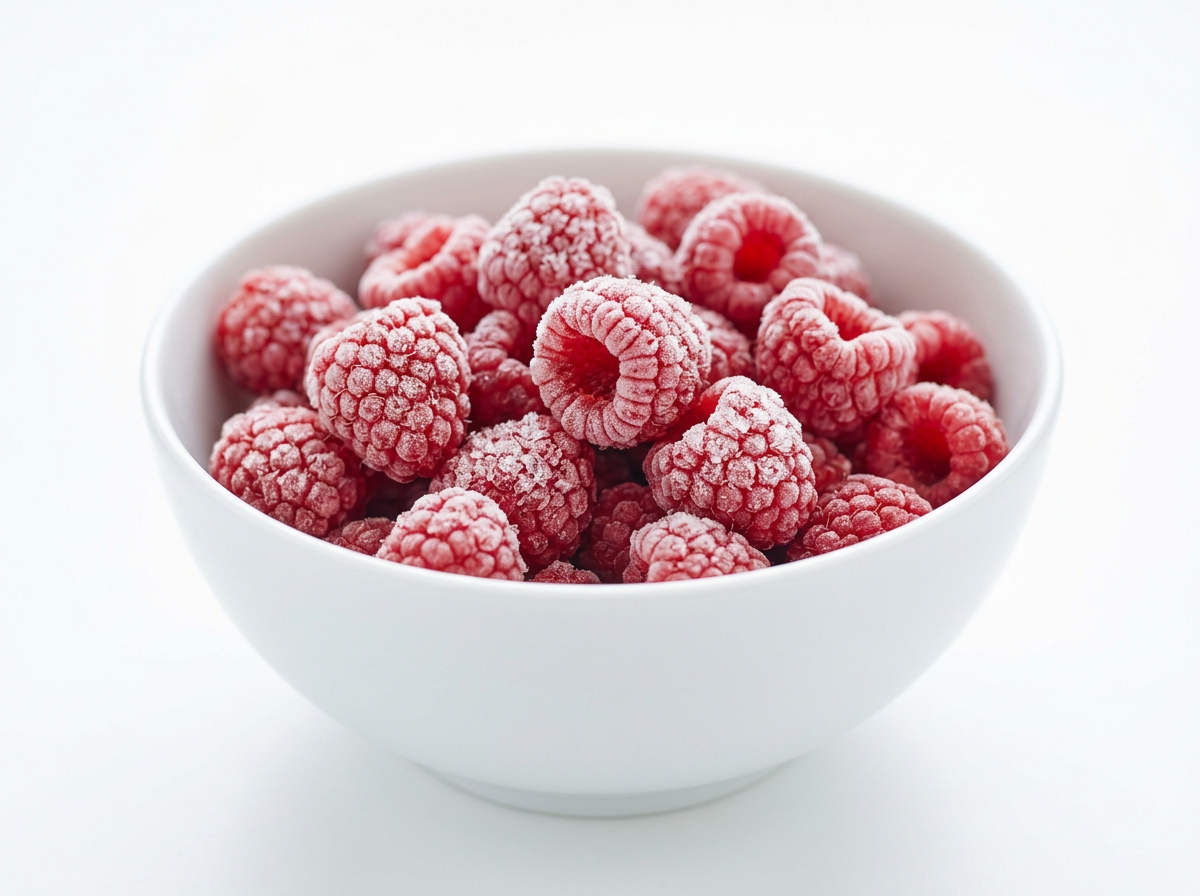
Use frozen when the fruit has to behave like fruit – wet, soft, with its own juice – and you have a cold chain. Use freeze dried when the fruit has to go into a dry matrix, survive ambient storage or travel without refrigeration, and you can accept the cost of removing the water.
The two formats are not competitors for most applications. They only look like competitors when a buyer compares a price per kilogram without noticing that one kilogram of freeze dried raspberry is roughly the fruit solids of a much larger quantity of fresh or frozen fruit, and that the water in the frozen product is doing useful work in some recipes and none at all in others.
| Criterion | Frozen (IQF) | Freeze dried |
|---|---|---|
| Preservation mechanism | Water immobilised as ice; microbial growth stopped by temperature | Water removed by sublimation under vacuum; growth stopped by low water activity |
| Typical residual moisture | Essentially the fruit’s own water content | Very low, in the low single-figure percentages |
| Water activity | High, but irrelevant while frozen | Low, which is the whole basis of ambient stability |
| Storage | Minus 18 degrees Celsius or colder, unbroken | Ambient, in a sealed moisture and oxygen barrier |
| Shelf life driver | Cold chain stability and packaging integrity | Packaging barrier, and to a lesser extent oxygen and light |
| Weight relationship | Close to the fresh fruit weight | A fraction of it; the fresh-to-dry ratio depends on the fruit’s water content |
| Price per kilogram as bought | Lower | Much higher |
| Price per kilogram of fruit solids | Higher than it looks, because most of the weight is water | Comparable or better than it looks, once the ratio is applied |
| Texture after use | Soft, juicy, releases liquid | Crisp and friable, or rehydrated to a soft but not fresh texture |
| Structure and appearance | Whole fruit shape retained if frozen quickly | Original shape and volume retained; the piece is intact but light |
| Transport | Reefer, with temperature evidence | Ambient, palletised, low weight per unit of fruit |
| Typical applications | Bakery fillings, puree, yoghurt, desserts, retail packs, smoothies | Cereal and snack inclusions, instant beverages, confectionery, nutrition powders, garnishes |
When to choose frozen
Choose frozen when the recipe needs the water. A fruit filling, a compote, a puree, a sauce, a smoothie or a yoghurt preparation is built around a fruit that gives up juice, and starting from a dry fruit means adding water back and rarely getting the same result. The pectin, the acidity and the released sugars behave differently in the two cases.
Choose frozen when the fruit is a large part of the finished mass. Frozen fruit is the cheaper way to buy fruit solids in bulk once you account for the fact that you are also buying water you would otherwise add. For anything above roughly a garnish-level inclusion, that arithmetic favours frozen unless the process is dry.
Choose frozen when you already have the cold chain. If a reefer is arriving anyway and the cold store exists, the marginal cost of a frozen ingredient is low. If it is not, the cold chain is a fixed cost that has to be earned back, and a small-volume dry ingredient will not earn it.
Choose frozen when the fruit needs to look like fresh fruit after thawing. Quick freezing keeps the piece structure well enough that a thawed raspberry reads as a raspberry. A freeze dried raspberry, rehydrated, reads as a rehydrated raspberry – the shape survives, the turgor does not.
When to choose freeze dried
Choose freeze dried when the product is dry and has to stay dry. A cereal, a snack bar, a chocolate inclusion, an instant drink, a dry mix – every one of these is destroyed by adding a wet ingredient. Water migration from a fruit piece into a biscuit or a chocolate is the classic formulation failure, and only a low water activity fruit avoids it.
Choose freeze dried when the supply chain has no refrigeration. An ambient pallet travels anywhere, sits in a normal warehouse and does not fail because a genset stopped. For export into markets without dependable cold storage, or for a product that will sit on a distributor’s shelf for months, that reliability is the product.
Choose freeze dried when weight and volume matter more than unit price. The removed water is removed freight. A pallet of freeze dried fruit carries the solids of a far larger frozen consignment, which changes the economics of long-distance and air movement completely.
Choose freeze dried when appearance in a dry product matters. Freeze drying is the drying method that preserves shape and colour best, because the water leaves as vapour from the solid state without the shrinkage and case hardening that hot air drying produces. That is why the visible fruit pieces in a premium cereal are usually freeze dried and the invisible ones usually are not. Freeze dried product as a form sets out the mechanism.
Choose freeze dried when the fruit is going into a nutrition or supplement format. Powdered and piece formats for nutrition products need a stable, low moisture raw material that can be milled, and the sublimation process is gentler on heat-sensitive components than hot air drying. Polyphenols and heat sensitive compounds covers what the evidence supports and what it does not.
What changes in your process
The switch is not a substitution in a recipe; it is a change of ingredient class.
- Hydration. Freeze dried fruit in a wet system will take up water from whatever is around it, changing the texture of the surrounding matrix as well as its own. Either accept it, block it with a coating, or use the fruit in a dry system.
- Dosing. The two formats are dosed on completely different masses for the same fruit content. Reformulating means recalculating on a dry solids basis, not swapping kilogram for kilogram.
- Storage. Frozen needs a cold store and temperature records. Freeze dried needs a dry store, an intact barrier and attention to opened-pack management, because a low water activity fruit in humid air picks up moisture quickly and loses its crispness first and its stability later.
- Handling. Freeze dried pieces are fragile. Conveying, mixing and pneumatic transfer break them into fines, and if whole pieces are the point, the process has to be designed around that.
- Specification. A frozen specification carries calibre, defects, drip loss and microbiology. A freeze dried specification carries moisture, water activity, piece size distribution, fines, colour and microbiology. They share very little.
What the table does not show
The price comparison only makes sense on a dry equivalent basis. Compare the cost of the fruit solids you actually need, not the cost of the bag. Take the fresh-to-dry ratio for that fruit, apply it to the freeze dried price to get a fresh-fruit-equivalent cost, and then compare with the frozen price adjusted for its own thaw loss. Freeze dried will still be dearer in most cases – it is an energy-intensive, slow, batch process – but the gap is far smaller than the headline prices suggest, and in a dry application there is no frozen option at any price. The frozen to freeze dried weight ratio explains where the cost sits.
The weight ratio is fruit-specific and it is a range, not a constant. It is set by the water content of the incoming fruit, which moves with variety, ripeness, season and growing conditions. A supplier quoting a single fixed ratio for all crops is quoting a planning figure. Ask what ratio applies to the specific fruit and crop being offered.
Shelf life is not a property of the fruit. For frozen product it is set by the storage temperature and its stability; for freeze dried it is set almost entirely by the packaging barrier and the headspace. A freeze dried fruit in a foil laminate with an oxygen scavenger and a freeze dried fruit in a simple polyethylene bag are different products commercially, whatever the certificate of analysis says on the day of packing. Water activity and shelf life sets out the relationship.
Freeze dried is not the same as dried. Most dried fruit on the market is hot air dried or otherwise dehydrated, which is a cheaper, faster process that produces a chewy, shrunken, darker product with a higher residual moisture. It is a good product for its own applications and it is not a substitute for freeze dried in a crisp inclusion. Dehydrated product as a form draws the line.
Neither format improves the fruit. Both preserve what arrives. A poor raw material frozen quickly is poor frozen fruit, and a poor raw material freeze dried is expensive poor dried fruit. The specification and the intake checks matter more than the format.
FAQ
How much frozen fruit does one kilogram of freeze dried replace?
It depends on the water content of the fruit, so the honest answer is a range rather than a number, and it should be taken from the supplier for the specific crop. Berries are high-moisture fruits, so the ratio is large – one kilogram of freeze dried berry represents many kilograms of fresh fruit. Use the supplier’s stated ratio for the lot, confirm it against the moisture result on the certificate of analysis, and build the recipe on that.
Can freeze dried fruit be rehydrated back to frozen-equivalent fruit?
It rehydrates well by the standards of dried fruit, because the sublimation process leaves a porous structure that takes water back quickly. It does not come back as fresh fruit. Cell walls that lost their water do not fully recover turgor, so the rehydrated piece is softer and less juicy than a thawed frozen piece. Where the rehydrated texture is the point, rehydration capacity should be in the specification.
Which format is better for nutritional content?
Both are gentler than hot processes, and comparative claims should be treated carefully because the published evidence varies by nutrient, by fruit and by how the comparison was run. Freezing holds heat-sensitive compounds well while the product stays frozen; freeze drying avoids the thermal load of hot air drying but exposes a large surface area to oxygen once the pack is opened. A specific claim on a specific nutrient needs analysis on the actual product, not a general statement.
Does freeze dried fruit need to be certified differently?
The food safety scheme requirements are the same in kind – a GFSI-recognised certificate covering the site and the process. What changes is the scope statement and the hazard analysis, because drying and packing under a moisture barrier are different processes from freezing, and the certificate has to cover the one you are buying.
Which is cheaper to ship?
Freeze dried, decisively, per unit of fruit solids. It travels ambient, weighs a fraction of the equivalent frozen fruit and needs no reefer, no genset and no temperature evidence. Frozen is cheaper per kilogram of product but carries the whole cold chain cost with it.