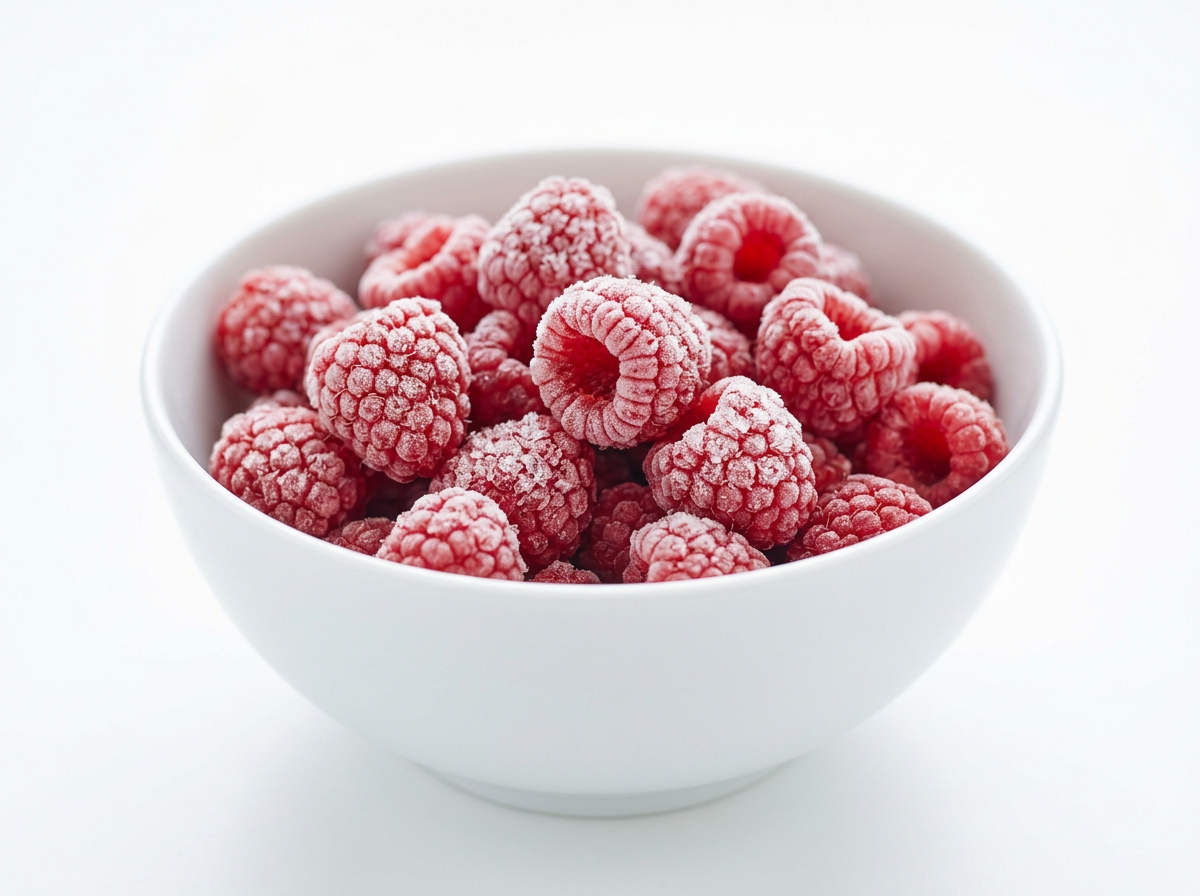
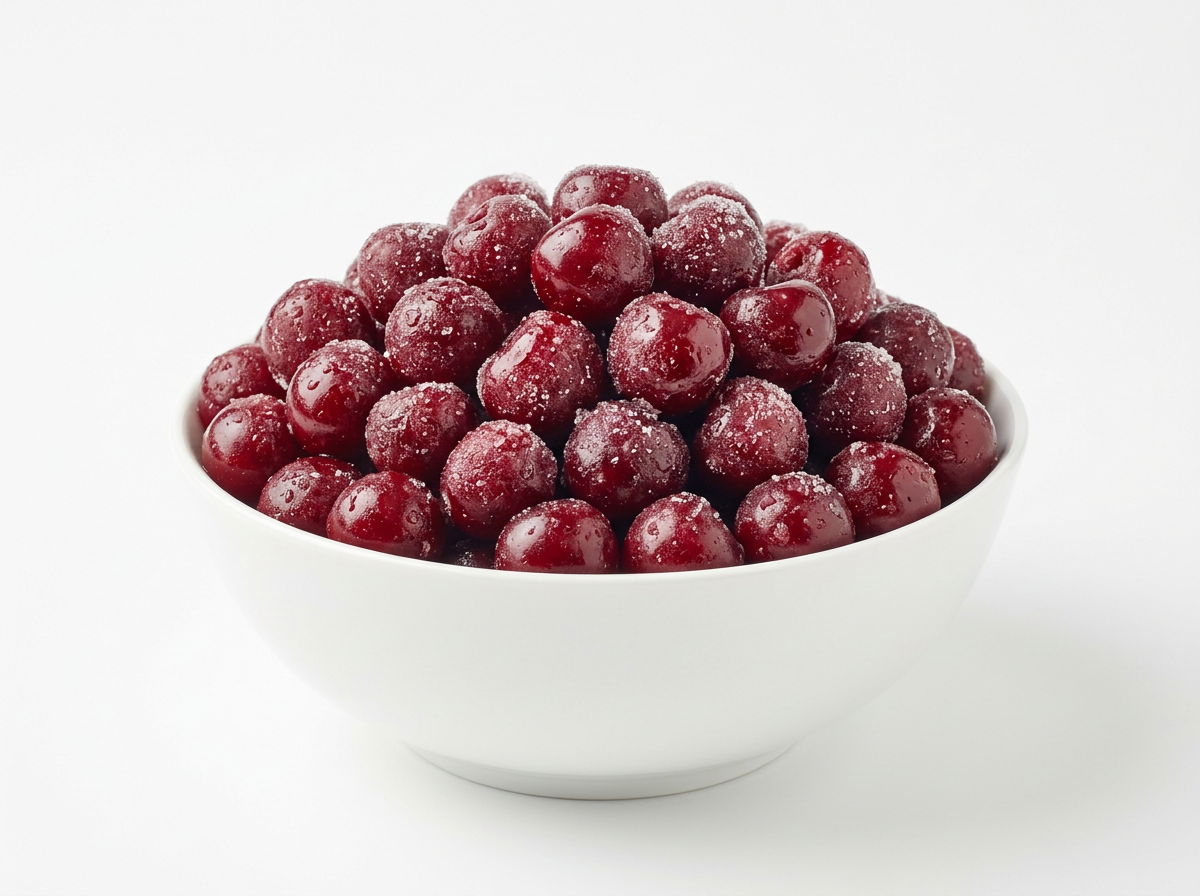
Buy IQF when the individual fruit has to survive, be counted, be portioned or be seen. Buy block frozen when the entire block is going into a puree, a juice, a jam, a filling or a bake, and nobody downstream will ever see a whole berry.
Those two sentences decide almost every case. The rest of this page is about the cases they do not decide, and about why an IQF quote and a block quote for the same fruit are not comparable numbers.
| Criterion | IQF | Block frozen |
|---|---|---|
| Freezing method | Fluidised bed or belt freezer, fruit separated in a cold air stream | Plate or blast freezer, fruit frozen in a filled carton or crate |
| Freezing rate | Fast, small ice crystals | Slow, large ice crystals |
| Product form | Free-flowing individual pieces | A solid mass, typically 10 to 25 kg depending on the pack |
| Portionability | Any quantity, straight from the pack | The whole block, or a sawn portion |
| Thaw loss | Lower, because cell damage is limited | Higher, and the block releases juice as it goes |
| Visual integrity after thaw | Recognisable fruit | Collapsed, and in soft fruit largely a puree |
| Price per kilogram | Higher | Lower |
| Typical end use | Retail packs, bakery topping, food service, mixes, smoothie packs | Puree, juice, concentrate, jam, filling, industrial ingredient |
| Processing equipment needed | None beyond cold storage and a scale | Tempering room or block cutter, and often a saw |
| Line throughput impact | Dose directly, no tempering step | Tempering time has to be planned into the schedule |
| Repack flexibility | Repack any size without thawing | Repacking means thawing or cutting |
When to choose IQF
Choose IQF when the fruit is visible in the finished product. A raspberry on a dessert, a strawberry in a fruit salad, a blackcurrant in a yoghurt inclusion – all of these need the piece to hold together through thaw, and only a fast freeze delivers that. The mechanism is ice crystal size: quick freezing forms small crystals that do less damage to cell walls, so on thawing the cell holds more of its water and the fruit keeps its shape.
Choose IQF when you dose by weight into varied recipes. A free-flowing product can be scooped, augered or metered at whatever quantity the recipe needs, and what you do not use goes back to the freezer. That is not a small operational advantage; it removes the “we opened a 20 kg block to use 4 kg” problem entirely, and with it the waste and the microbiological risk of a partially thawed block returning to store.
Choose IQF when your buyer is a retailer or a food service operator. Consumer packs and food service portions are effectively IQF-only categories, and a specification for retail frozen fruit will assume it without saying so.
Choose IQF when drip loss is a cost. In a filling or a topping where the water phase matters, a higher thaw loss is a yield loss and a texture problem in the same event. Paying more per kilogram for fruit that gives back more usable mass can be the cheaper option once the yield is counted, and that arithmetic is worth doing explicitly rather than assuming.
Choose IQF when you need calibre control. Sizing and grading are done on separated fruit, so an IQF specification can carry a calibre range, a defect tolerance and a piece count in a way that a block cannot. Defect classification explains how those tolerances are written.
When to choose block frozen
Choose block frozen when the fruit is going to be destroyed by the process anyway. If the next step is a mill, a press, a pasteuriser or a cooking kettle, the cell damage from slow freezing is irrelevant, because the process would have caused it. Paying an IQF premium for fruit that will be puree within an hour is paying for a property you are about to remove.
Choose block when you buy in whole-block quantities and run continuously. A jam line, a juice plant or a puree operation that consumes several blocks per batch has no dosing problem, and block frozen is the cheaper raw material per kilogram of fruit solids delivered.
Choose block when the fruit is a variety or a grade that does not IQF well. Very ripe fruit, small-calibre fruit and some varieties simply do not come off a fluidised bed freezer as clean separated pieces, and forcing them through the process produces clumping and a poor yield. Where the fruit is destined for processing, block avoids a step that adds cost and removes nothing.
Choose block when storage cost and density matter. A block occupies less volume per kilogram than free-flowing fruit with air between the pieces, so the pallet carries more fruit and the cold store holds more. On long storage of an industrial raw material, that difference is a real line in the cost.
Choose block when you want to reduce the surface area exposed to the freezer atmosphere. A solid block has far less exposed surface than the same mass of separated pieces, which is one reason block product is less prone to freezer burn and dehydration over a long storage period, provided the packaging is intact.
What changes in your process
The block decision imports a tempering step into your production schedule, and this is the point most often missed at the quotation stage. A 20 kg block does not become usable because someone moved it to a warm room; it needs a controlled temperature and a planned time, and the plan has to keep the fruit out of the temperature range where microbiological growth becomes an issue. That means either a tempering room with a schedule, or a block cutter or saw that lets you take a frozen portion without thawing the rest.
- Space. A tempering room is floor area that is not producing anything.
- Time. Tempering is measured in hours, so the production plan has to reach back into the previous shift.
- Risk. A partly thawed block that goes back to the freezer is a quality problem and a traceability problem. Frozen berry storage and transport covers why.
- Labour. Handling 20 kg blocks is heavier work than handling free-flowing fruit in cartons or bags.
IQF imports a different set of issues. Free-flowing product is only free-flowing while the cold chain holds; a temperature excursion partially melts the surface and the pieces refreeze into a solid mass, which arrives looking like block frozen fruit you paid an IQF price for. Clumping is the diagnostic for this, and it is the single most common IQF claim.
IQF also asks more of your packaging and your storage discipline, because more exposed surface means more dehydration risk over time, and it asks more of your intake inspection, because the specification you are paying for is a piece-level specification that can only be checked on separated fruit.
What the table does not show
The price gap is not a fixed percentage. How much more IQF costs than block depends on the fruit, the season, the calibre, the yield through the freezer and how tight the crop is. The general shape holds – IQF is dearer – but a specific gap quoted as a rule of thumb will be wrong within a season. Ask for both prices on the same fruit, the same crop year and the same delivery term, and compare those.
Compare landed cost per kilogram of usable output, not per kilogram purchased. Thaw loss, cutting waste, tempering labour, the space cost of a tempering room and the value of the fruit you cannot dose accurately all belong in the comparison. For a puree line the answer will still be block. For a bakery filling with a visible fruit piece, it frequently is not.
“IQF” is a claim about process, not a guarantee of state. Product frozen individually and then abused in transit arrives as a block. The evidence that the product is what the invoice says is the temperature logger record, plus the state of the goods at intake. Specify both.
Block frozen is not automatically lower grade. The fruit going into a block can be exactly the same fruit going into IQF; the format is a decision about the freezer, not a statement about the raw material. A block made from good fruit under a proper specification is a good industrial raw material. Judge grade from the specification and the intake results, not from the format.
The specification has to change with the format. A calibre range and a piece count are meaningless on a block. A block specification is written around fruit variety and origin, Brix, acidity, defect and extraneous vegetable matter tolerances assessed on a thawed sample, drained weight where relevant, and microbiological criteria. Writing an IQF specification and buying block against it produces disputes that neither party can win.
FAQ
Is IQF fruit better quality than block frozen?
It is a different format, and it preserves piece integrity better because it freezes faster. Whether that is “better” depends entirely on whether piece integrity matters in your process. For a jam producer it is a property being paid for and then destroyed; for a retail packer it is the whole product. The short answer version covers the same ground in brief.
Can block frozen fruit be converted to IQF?
Not meaningfully. Thawing a block and refreezing the pieces gives you damaged fruit with high drip loss, poor appearance and an unacceptable process history. The format is set at the freezer, not afterwards. If you need IQF, buy IQF.
How much thaw loss should I expect?
It varies with the fruit, the ripeness at freezing, the freezing rate and how the product was stored, so a number quoted without those variables is not useful. What is reliable is the direction: block frozen soft fruit loses substantially more on thawing than the same fruit frozen individually, because slow freezing forms larger ice crystals that rupture more cells. Run a drip loss test on a sample from the actual lot if the number matters to your yield.
Which format is used for organic fruit?
Both. The organic status attaches to the fruit and its chain of custody under the EU organic rules, not to the freezing format. What changes with organic is the segregation and documentation requirement, which applies equally to a block and to a bag of IQF.
Does block frozen store longer?
Under equivalent storage conditions the difference is mostly about exposed surface. A solid block dehydrates more slowly than the same mass of separated pieces, so on a long hold in a store with any temperature fluctuation, block product tends to hold appearance better. That said, storage life is decided by the storage temperature and its stability far more than by the format, and both are stored at minus 18 degrees Celsius or colder.