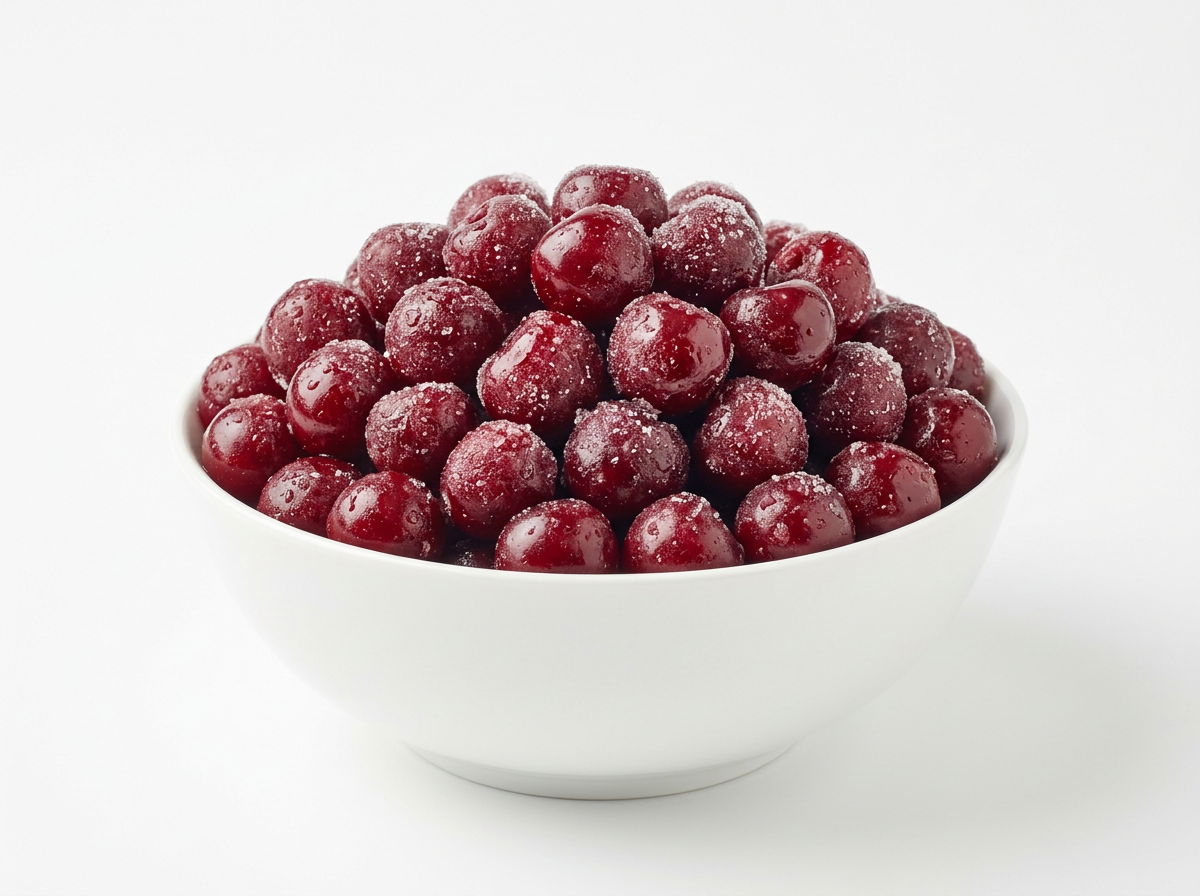

The species, and what each is bought for
Ukrainian stone fruit exports concentrate on four species, and each has a distinct commercial personality.
Sour cherry is the volume and reputation line. Ukrainian sour cherry has genuine standing in European industrial fruit sourcing, mostly as pitted IQF for bakery filling and dairy. The pitting quality is the whole argument.
Plum splits in two. Drying varieties go to prune production, a trade with its own grading vocabulary built around size counts per unit weight and moisture classes. Fresh-market and processing varieties go to freezing and puree.
Apricot is the highest-value freezing line and the most weather-exposed. Ukrainian apricot halves compete on colour and cavity cleanliness rather than on cost.
Peach is the newest at commercial processing scale. Peach slices are the dominant form, because the freestone and clingstone distinction makes halving less reliable than it is in apricot.
The processing chain, step by step
Stone fruit processing is a short chain with three genuinely difficult steps.
- Intake and maturity assessment. Fruit arrives in field crates within hours of picking. Maturity is assessed against a target band rather than a single point, because the same block ripens unevenly. Over-mature fruit will not survive pitting; under-mature fruit will not develop colour or flavour after freezing.
- Washing and sorting. Flume washing followed by an inspection belt, then usually colour sorting to pull immature and damaged units. This is where the ceiling on the finished grade is set.
- Size grading. Not cosmetic. Grading into narrow bands is what allows the pitter to be matched to the fruit, so size grading is a food safety control dressed as a quality step.
- Pitting or halving. Mechanical pitting for cherry and plum; orienting halvers for apricot. Throughput and fragment risk trade against each other directly, and a supplier running above the designed rate is buying throughput with fragment risk.
- Fragment inspection. X-ray, optical, or both in series. Verification frequency with test pieces is the number that matters.
- Freezing. Fluidised bed IQF for slices, dice and pitted whole fruit; belt tunnels for halves that need to keep their orientation. Halves sometimes justify a slower profile, because cavity collapse costs more than a marginal gain in ice crystal size.
- Packing and cold storage. Polyethylene-lined cartons into a maintained cold store, with the packaging declaration of compliance kept on file.
The stone fruit processing guide covers the equipment choices and the failure modes at each step.
Specification points that decide acceptance
| Parameter | Why it decides acceptance | What to require |
|---|---|---|
| Pit and pit fragment control | Physical hazard, recall-grade failure | Named detection method, verified sensitivity, verification frequency |
| Halving accuracy | Drives visible yield in the finished product | Percentage of true halves versus broken and irregular, measured on a defined sample |
| Cavity cleanliness | Residual stem, skin flap and adhering tissue | Defect definition with photographs agreed in advance |
| Colour | Season-dependent, especially apricot | A range with a reference, not a single target |
| Firmness after thaw | Predicts behaviour in the buyer’s process | Assessment after a controlled thaw, not on frozen samples |
| Drip loss after thaw | Indicates freezing rate and handling history | A stated method, since results are meaningless without one |
| Free-flow behaviour | Determines whether the product runs in the buyer’s line | Assessment after a simulated temperature excursion |
The last three are where sample evaluation usually goes wrong. Frozen fruit assessed frozen tells you almost nothing about how it will behave in a bakery depositor or a dairy dosing line. Thaw a defined mass under a defined regime, and record the result the same way each time.
Seasonality and how to contract around it
Stone fruit does not offer year-round contracting comfort. Cherry runs first, followed by apricot, then plum and peach, and the total commercially useful window is roughly ten weeks. Two consequences follow.
The first is that the volume decision has to be made before the season, not during it. Processors commit tonnage against contracted blocks; a buyer arriving mid-season is buying whatever is left after those commitments, at whatever grade remains.
The second is that a single frost event at flowering can remove a large share of the national crop, and it does so months before any fruit exists. Buyers who need supply certainty carry a second origin, contract a volume band rather than a fixed tonnage, or accept a wider specification in a short year. Buyers who do none of these discover the problem in July.
The availability calendar sets out the windows species by species, and the frozen fruit sourcing guide covers the contracting mechanics.
Compliance notes specific to stone fruit
Most of the horizontal requirements are the same as for the wider fruit range, but three points are specific enough to call out.
Hydrocyanic acid occurs naturally in stone fruit kernels. It is not a concern in properly pitted flesh, but it is one reason kernel fragments are treated as a compositional issue and not only a physical one, and it is why buyers should resist the idea that a small fragment tolerance is cosmetic.
Sulphur dioxide is used in some dried stone fruit lines, particularly light dried apricot. Where it is used it is an allergen-adjacent labelling matter under Regulation (EU) No 1169/2011 and an additive matter under Regulation (EC) No 1333/2008. Ukrainian dried plum is conventionally produced without it, but the declaration should be explicit rather than assumed.
Pesticide residues under Regulation (EC) No 396/2005 apply species by species and active by active. Stone fruit residue profiles differ meaningfully from pome fruit profiles, so a screen designed for apple is not a screen for apricot. Ask which panel was run.
Related records
Pitted sour cherry, pitted sweet cherry, apricot halves, peach slices and prunes are the core records. For destination-side requirements see the market profiles, and for the corridor mechanics see logistics.